For the ones who refuse to settle.
Tired of hearing it can't be done?
It usually just means nobody was good enough to do it yet.
In this industry, no is the default answer.
We ally with the ones who challenge the status quo and strive for excellence.
Nobody says it will be easy; we refuse to call it impossible.
In short: full-body sublimation on glass — unlimited colour, challenging shapes welcome, production-line sample in five working days. This page is the working manual for designing it.
Unlock your creativity.
The full 360°
The whole surface of the bottle is yours — base to neck, no seam, no safe zone, no back side.
No colour limits
Gradients, HD detail, unlimited colours at no cost per colour. If you can design it, it can print.
The difficult areas
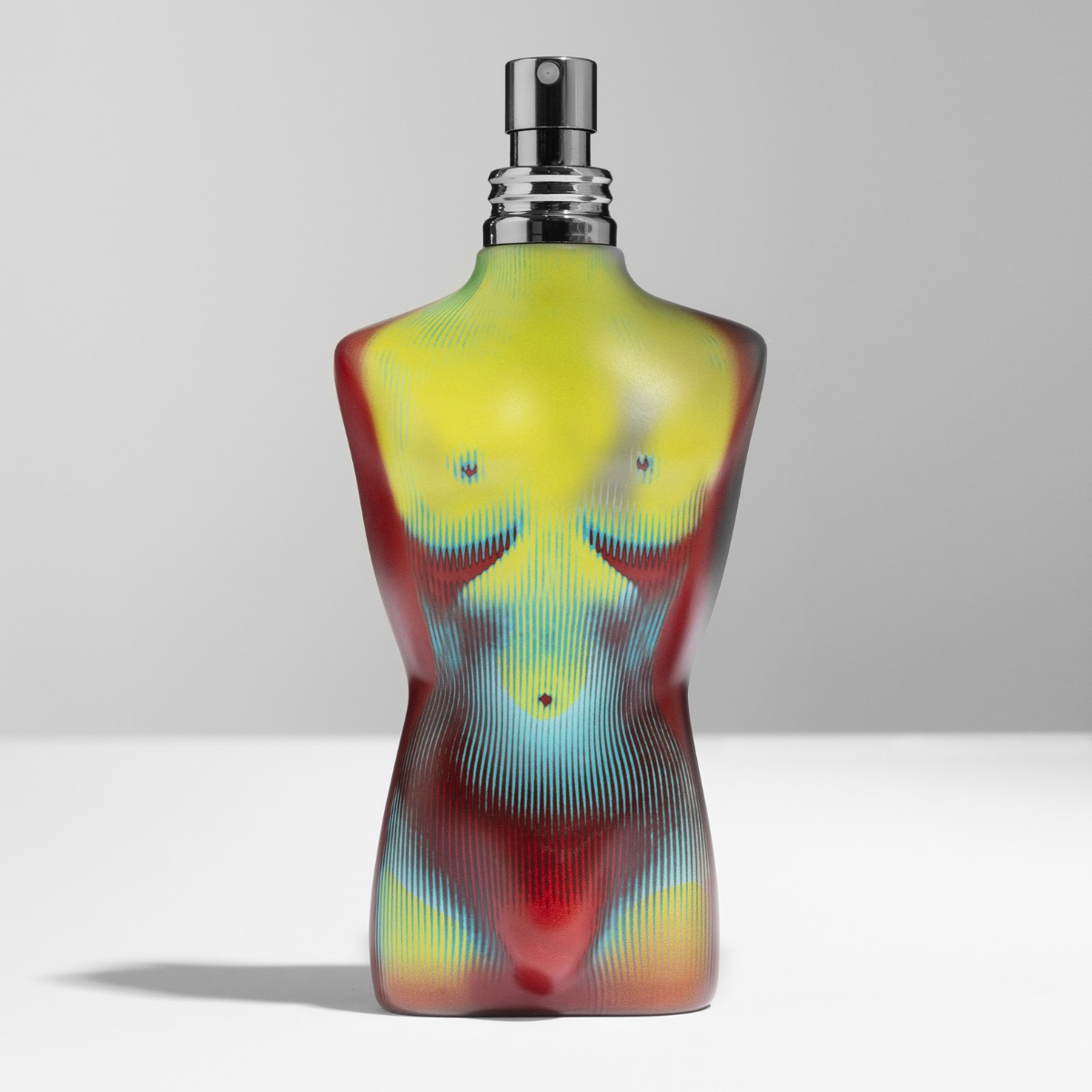
Shoulder, neck, bottom — the zones other decoration methods avoid can now be part of the canvas.
Over embossing
Raised glass, recessed surfaces, complicated geometry — the decoration follows the shape.
Challenging shapes welcome
We specialise in the shapes that are usually left out of the game — the ones decoration lines turn away.
This is sublimation. Just sublime.
Sublimation prints digital CMYK. Every shade is a composition built in quadrichromy — not a Pantone pulled from a swatch card — which is what gives you virtually infinite shades and gradients, at no cost per colour. (Practical note for your studio: the file will be CMYK, not RGB.)
Sublimation is a physical state change: matter passes directly from the solid state to the gas state, without ever becoming liquid. In sublimation on glass, what sublimates are the CMYK printing inks: during thermal transfer they turn to gas and migrate into the primer, so the colour ends up inside the coating — not printed on top of the glass the way a screen print is. That is why sublimation inks carry no metallic particles and no resin, and why they have no coverage of their own: sublimation colour is see-through. Think of writing on glass with a highlighter, not a paint marker.
Build from the ground up
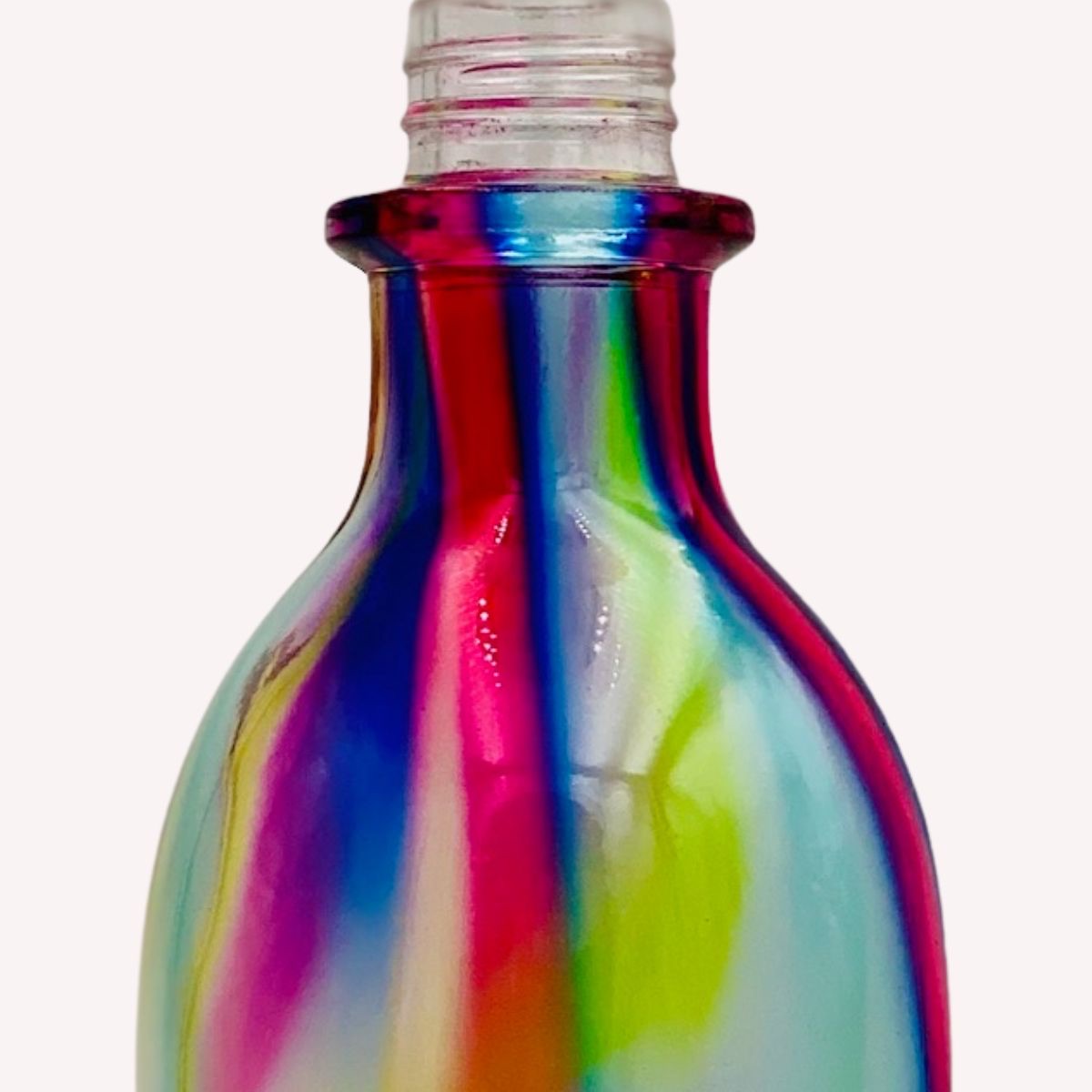
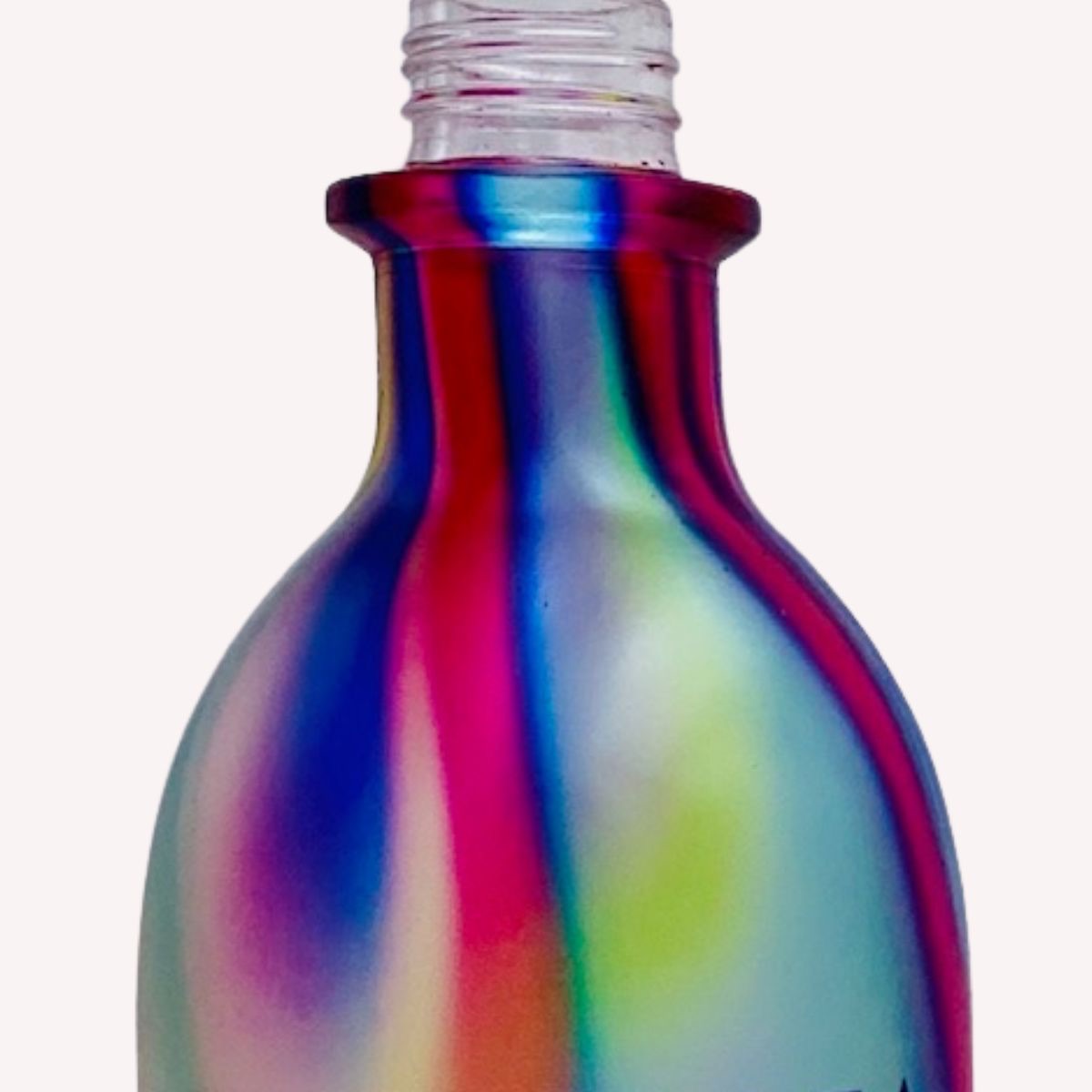
The primer is a creative step, not a technical preliminary. It supplies everything the inks can't: coverage from clear to fully opaque, the white, and the colour or effect underneath — pearl, metallic, even a light tint. It's also why light grounds beat dark ones: see-through colour needs light beneath it to show. Choose a shimmery, matte or translucent base, and the same artwork acquires a completely different character. Which is why designing a sublimated bottle starts one layer earlier than you'd think — primer first, then coverage, then artwork.
See it for yourself — the same design, primer to primer.
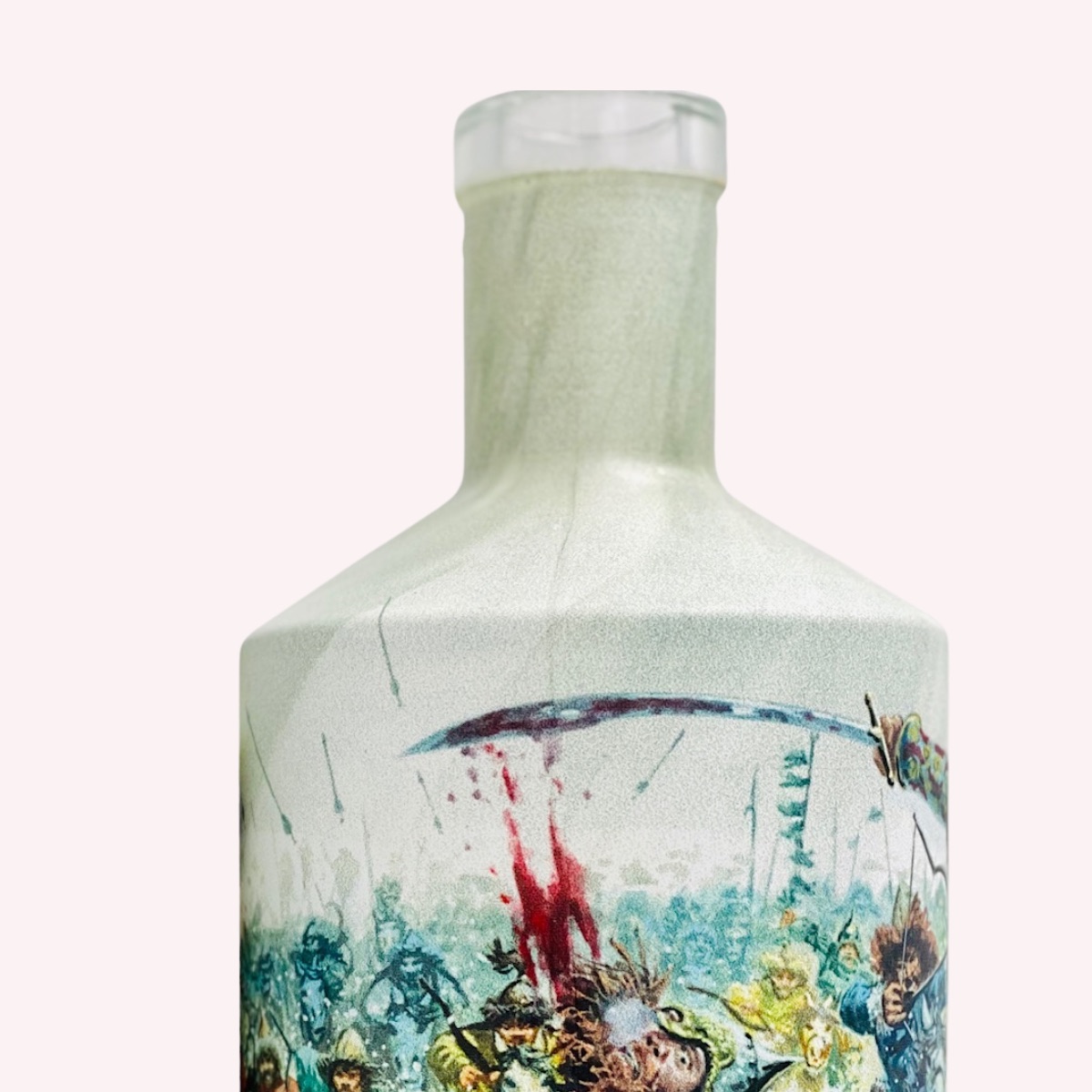
Levels of transparency
Coverage is a scale of transparency: from fully transparent to fully covering, with everything in between — how much light passes through, and how much of the glass stays in view. And every level works in both gloss and matte effect.
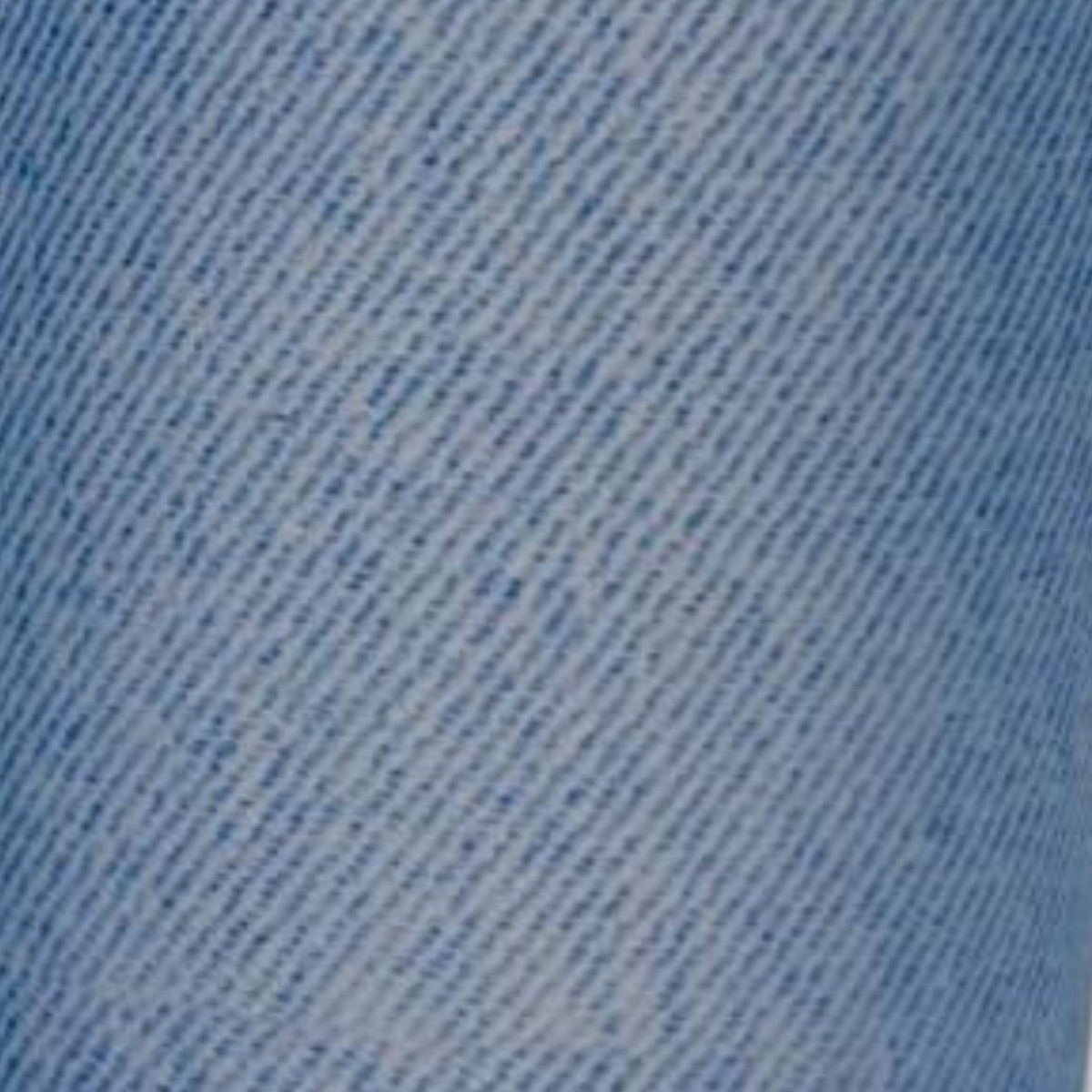
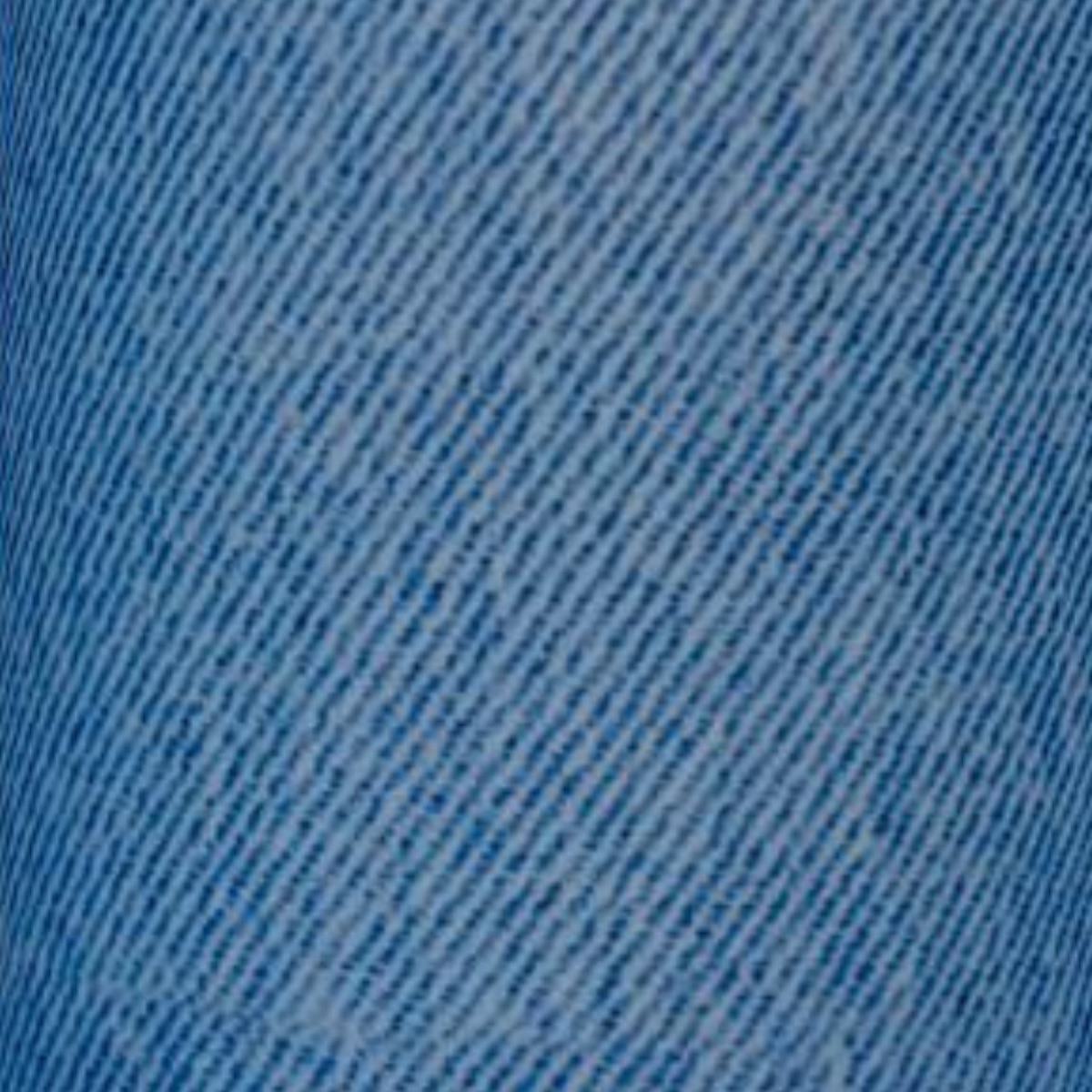
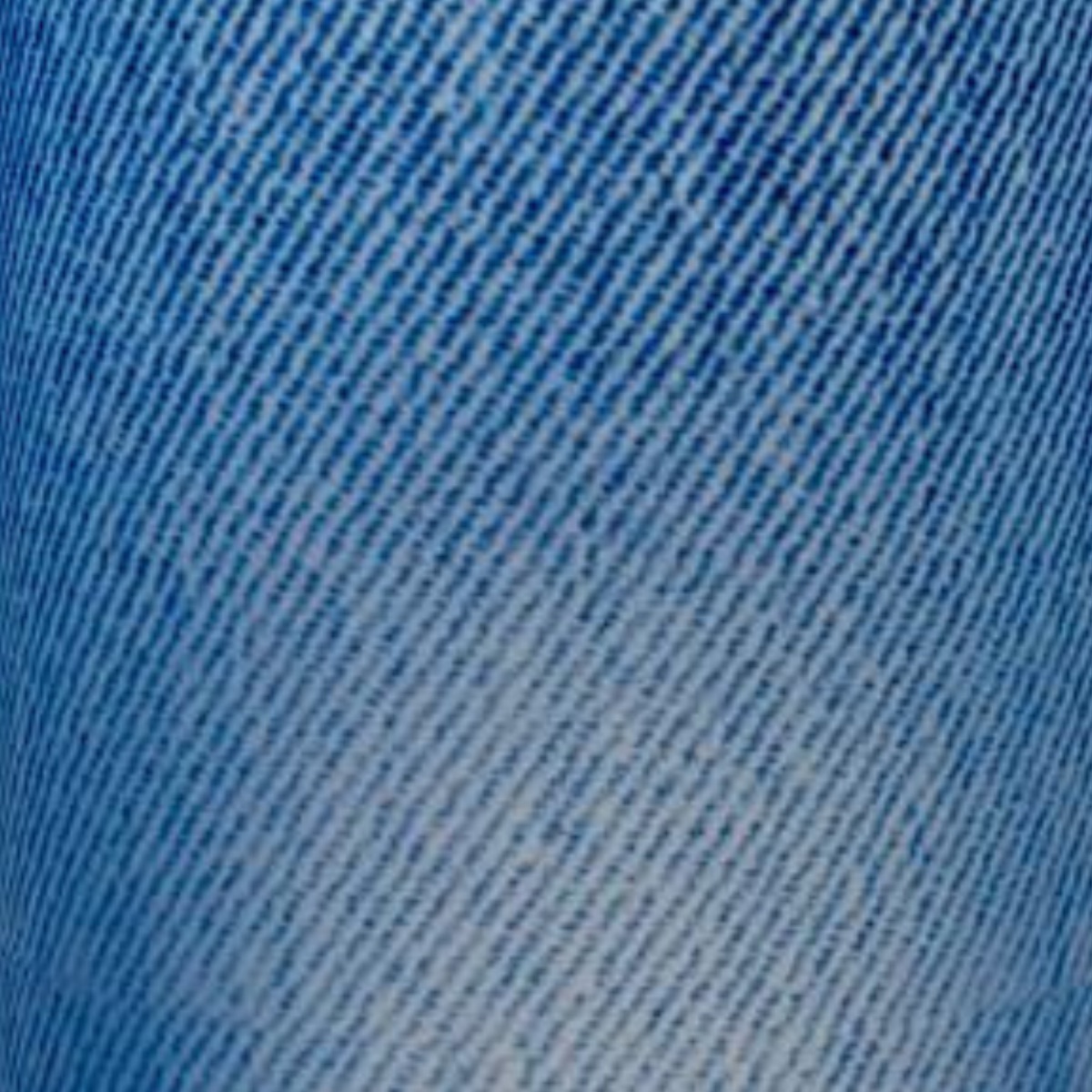
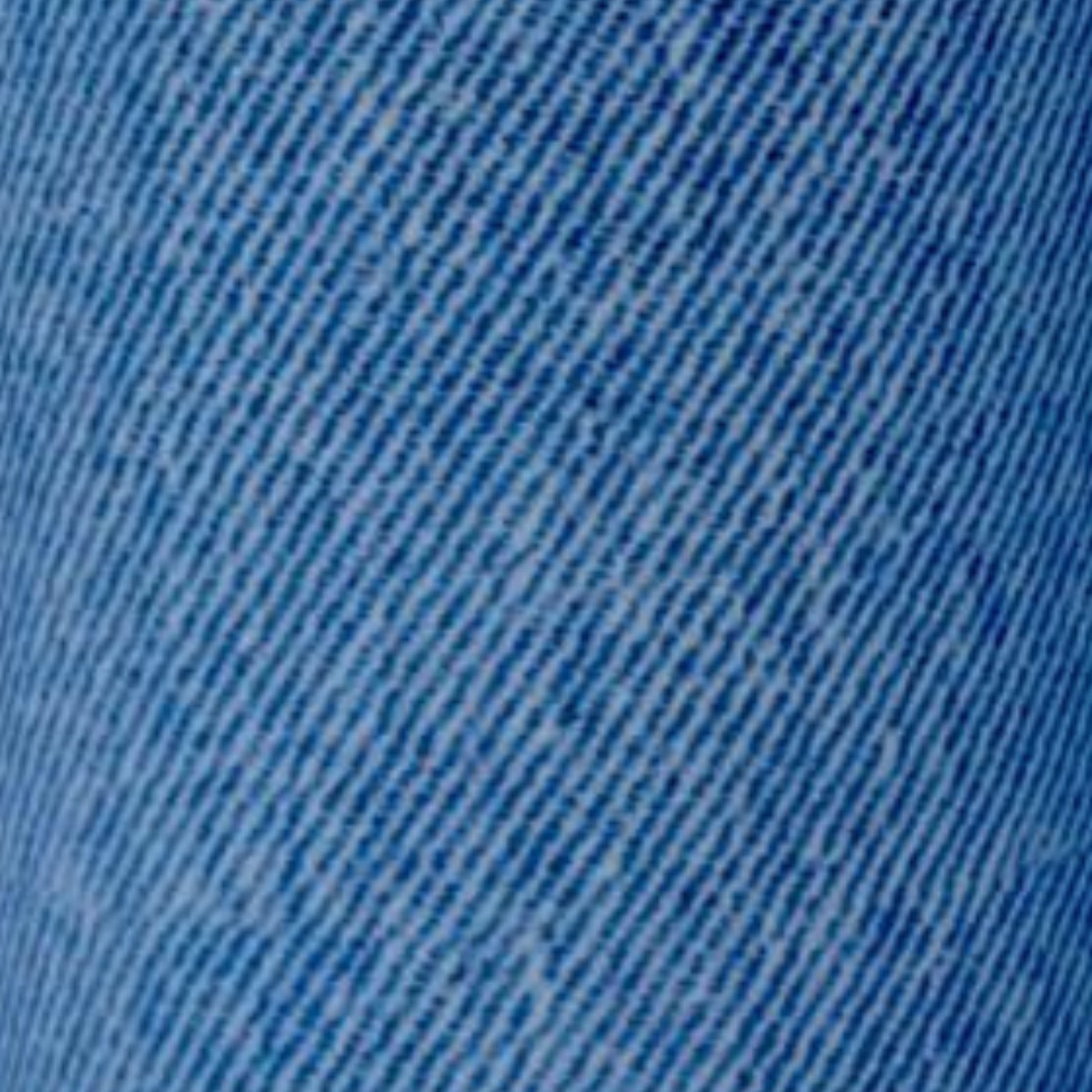
The PPWR angle. Europe's packaging regulation cares about what happens at the recycling plant — where glass is recognised optically, by the light passing through it. A decorated bottle still needs to read as glass, which makes transmittance a design parameter, not an afterthought. Decoration fused into the surface, with no plastic added, keeps the bottle glass — in hand and on the sorting line. What PPWR means for luxury packaging →
Gloss, matte, metal — and the wild cards
Every base can be glossy or matte — clear, white or metallic — and that's before the special effects begin. The family below is a starting point — and so are the primer selection on our site and the swatch kit. The real limit is your imagination: the base can be almost anything you want it to be.
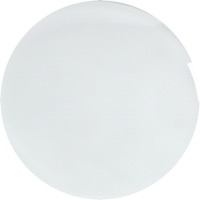
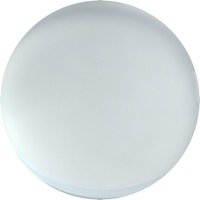
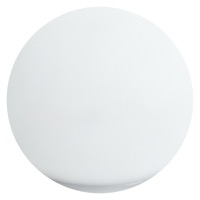
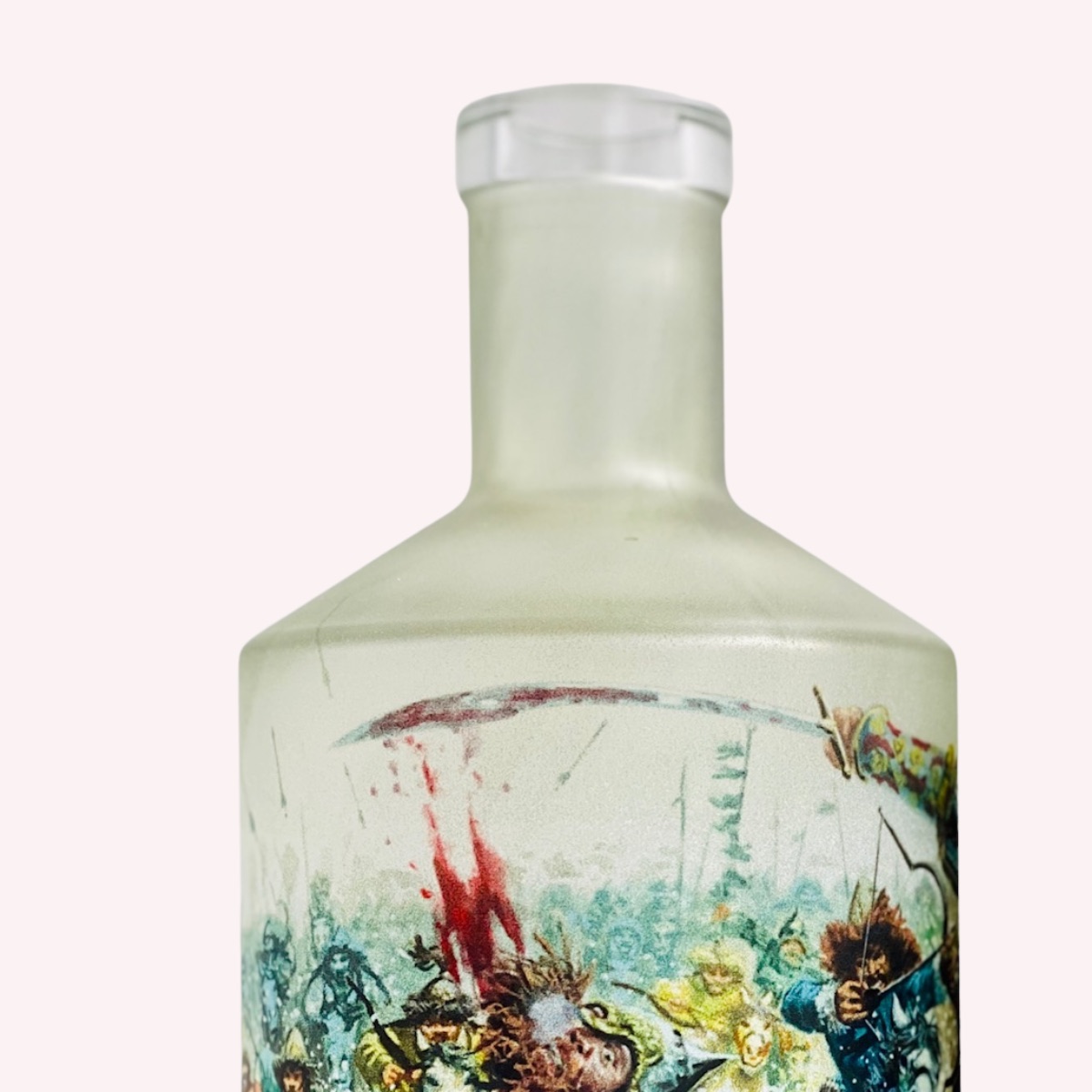
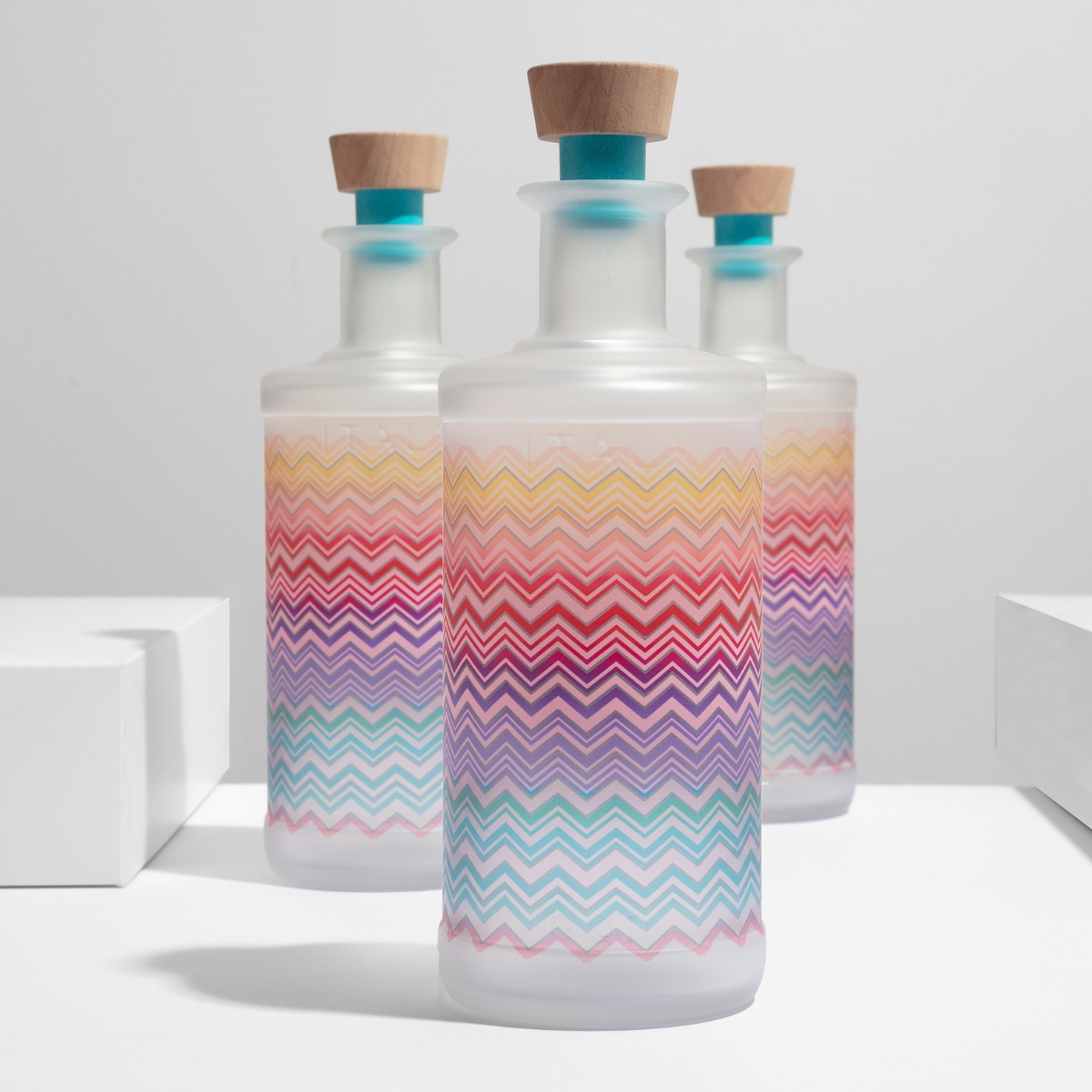
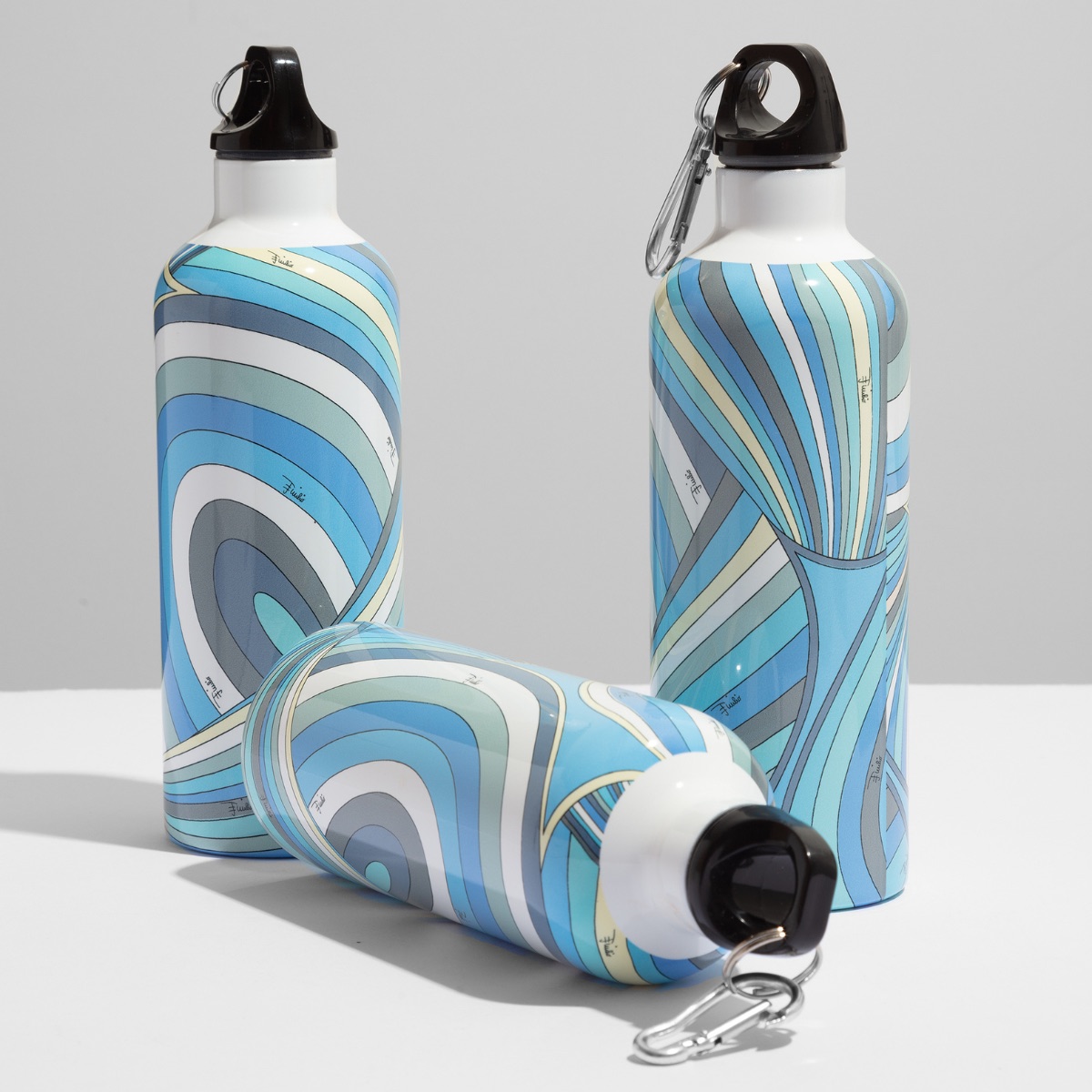
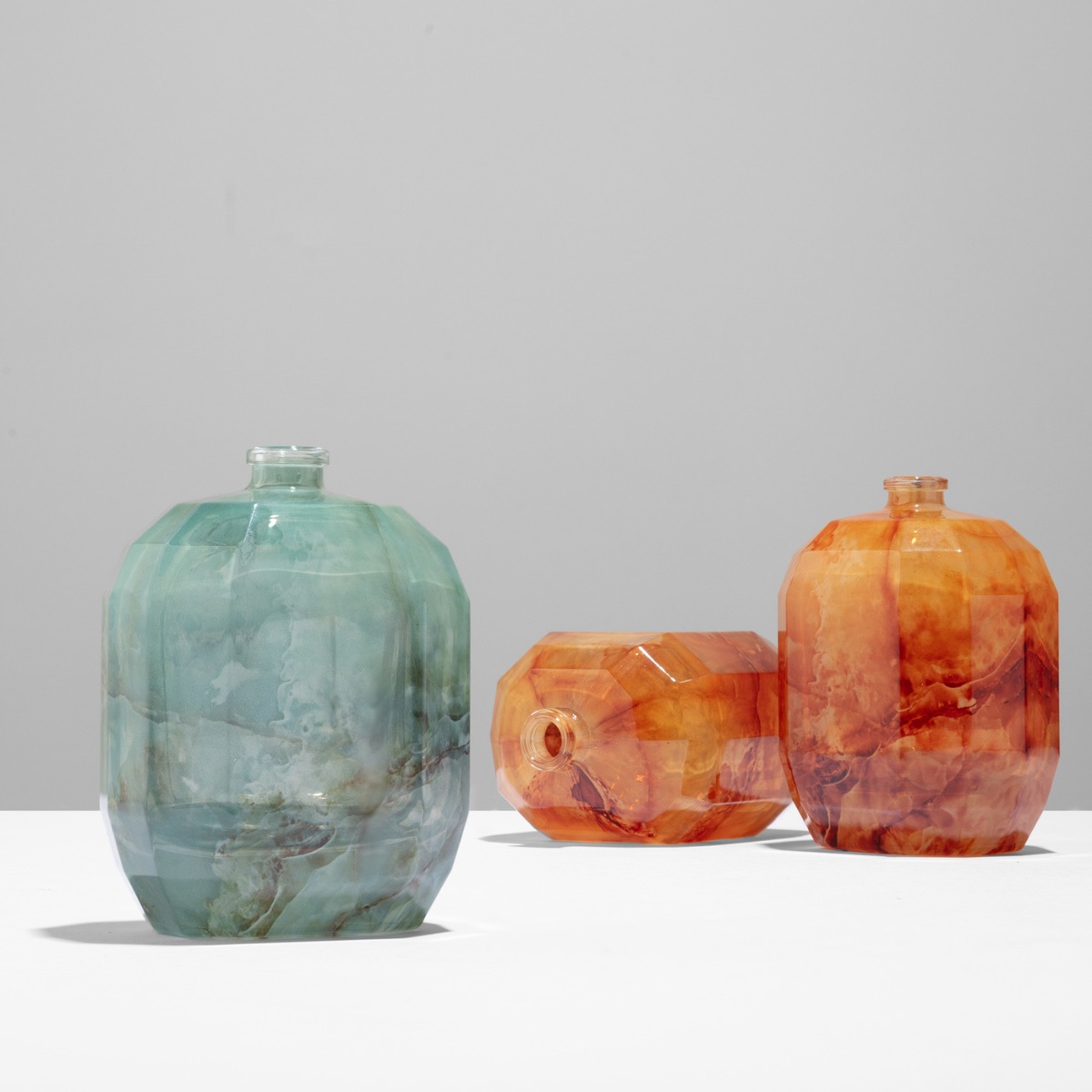
Real product examples — primer by primer.
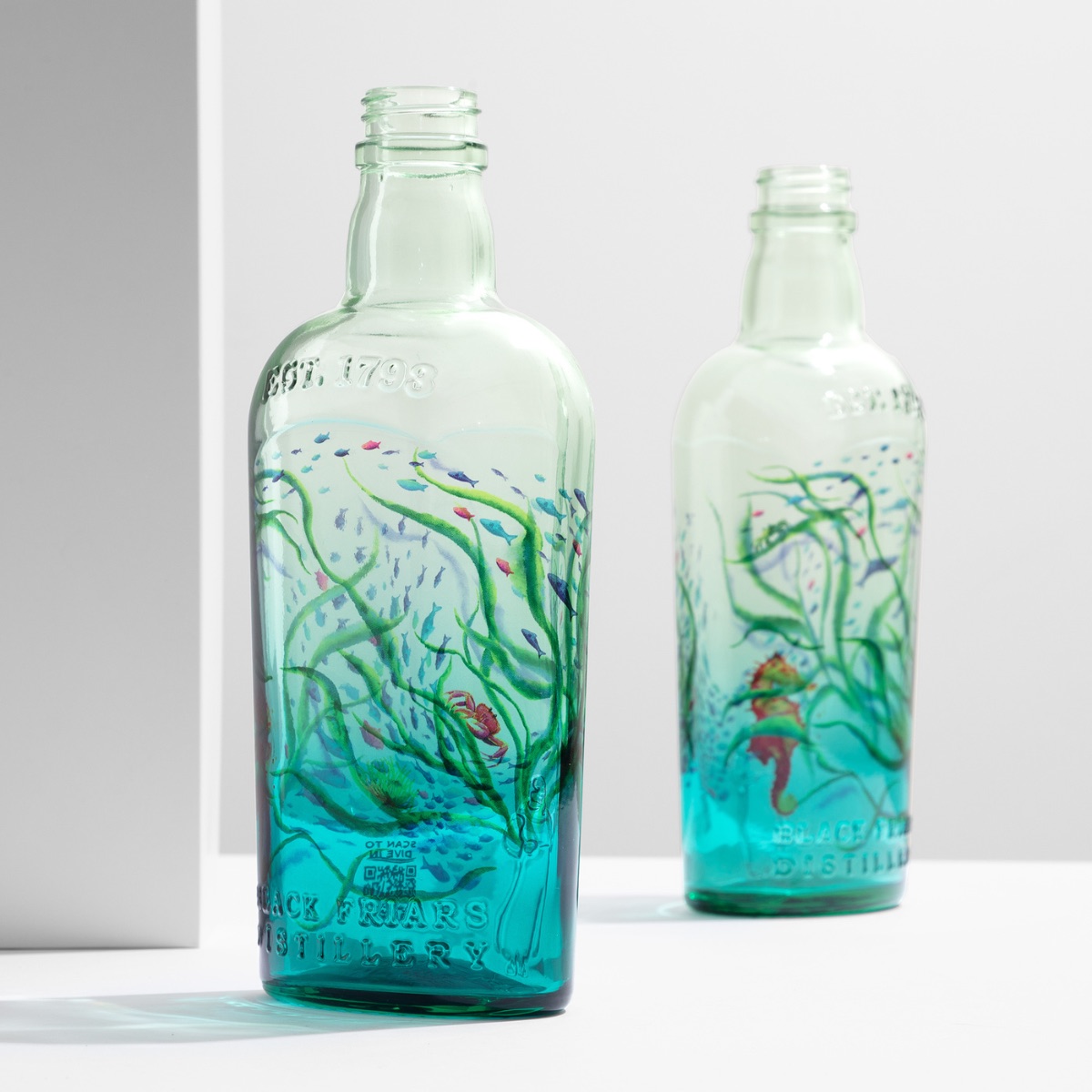
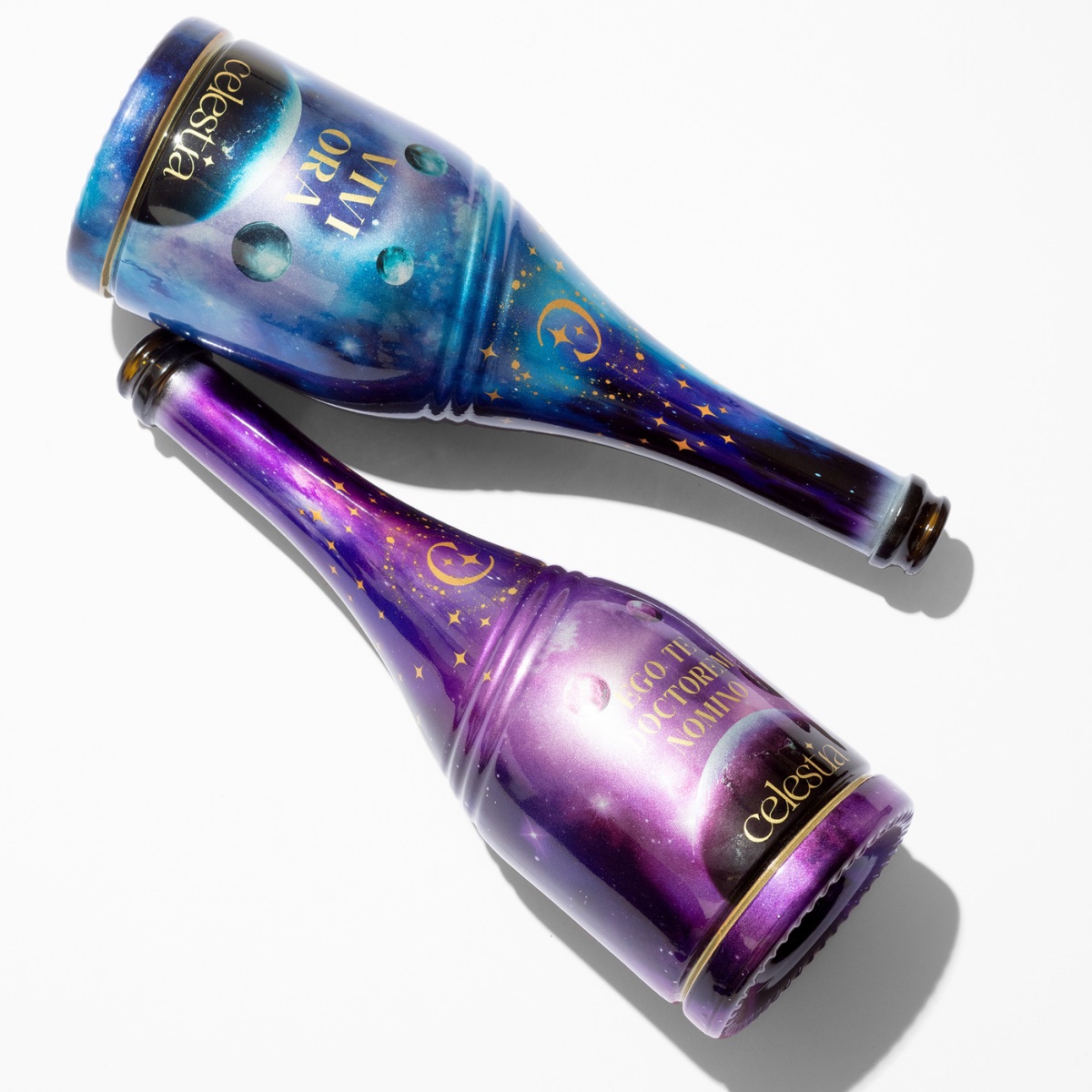
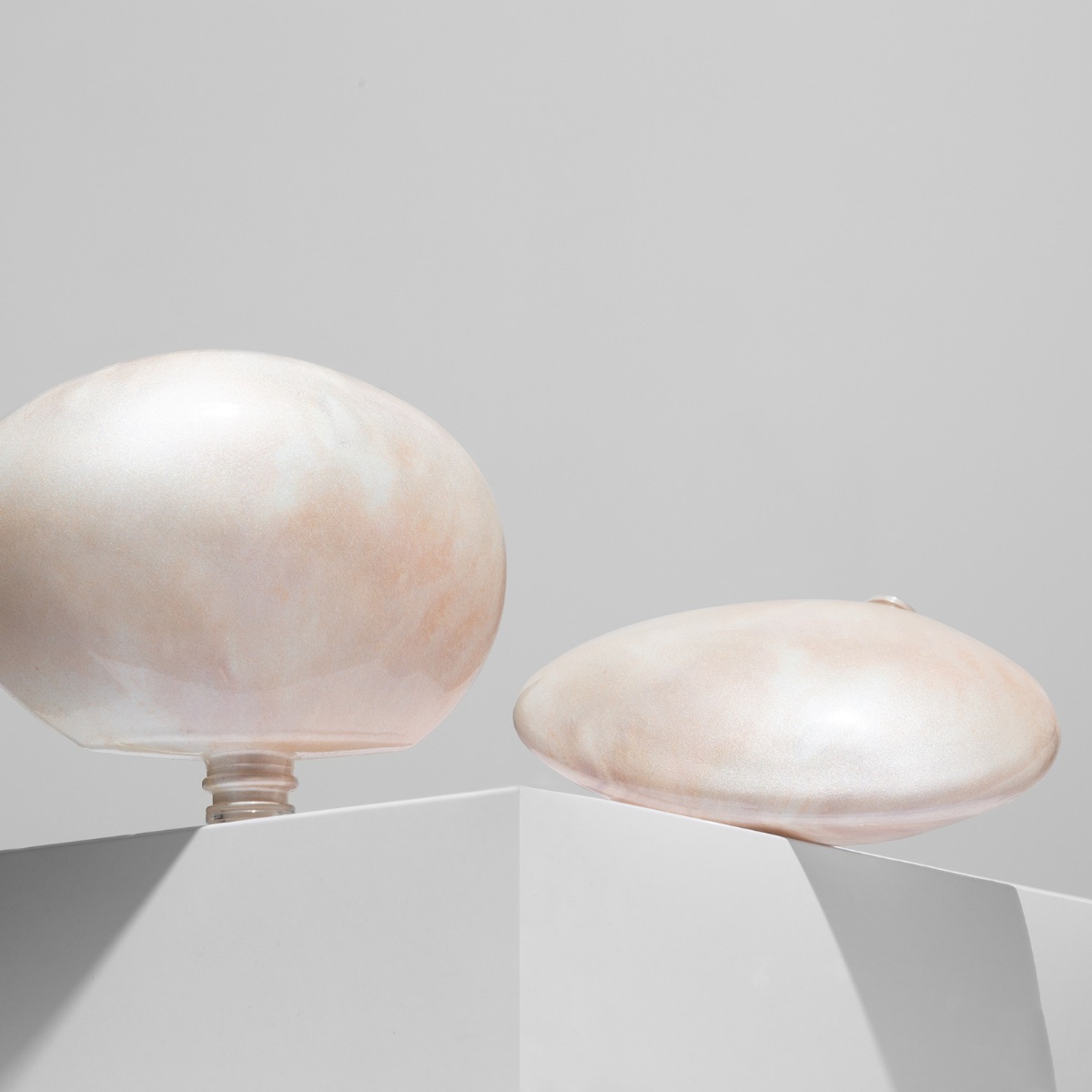
If it's on your screen, it can live on the glass
This is where sublimation unleashes the glass's full potential — and takes your project to the next level. Natural materials, painterly texture, HD photography, actual illustration — everything you would design for a box or a shrink sleeve can be carried onto the bottle. The difference is the result: it will look and feel like glass, which reads premium in a way film never does.
Only two things ask for attention.
Distortion
Flat artwork takes the bottle's shape, and on curved areas it deforms — geometry, not a flaw. It's calibrated on the specific component before a single bottle is made: if your studio works with distortion curves, we supply them; if not, our team pre-distorts the artwork for you — spread across the surface, the deformation is homogeneous, and on the finished bottle it's never obvious.
The joint
On a full 360° wrap the artwork meets itself, and the meeting point is disguised inside the design — through pattern, texture or other stylistic devices.
Plan those two early.
Then break every other rule.
And because the decoration is fused into the surface, not wrapped over it, the bottle keeps the weight, the cold, the touch of real material in hand — unless you want that look, it should never feel plasticky. What you approve on a render arrives on the shelf: expect roughly 95% fidelity, with a real sample made on the production line in five working days, at zero development cost.
| Resolution | Up to 1200 dpi |
|---|---|
| Colour profile | CMYK, not RGB — shades built in quadrichromy, matched against Pantone or Cromalin references in calibrated CMYK |
| Bleed & safe zones | Marked per component on ATIU's template, supplied together with the distortion curve for your specific bottle |
| Minimum order | 5,000 pieces — scaling to millions of units per project |
Book a call with Martina
Want to know more about the technology and what it could do for your next project — including examples we haven't published on the site? Book a call with our expert, Martina: she'll be happy to walk you through the technical side and the full creative potential of sublimation, on your specific case.
Book a call →Bridging the gap between online and offline
AI, CGI, gaming and social media have accustomed a generation to extraordinary visual experiences — and traditional packaging technologies were never designed to recreate them. Sublimation closes that gap: it carries a digital aesthetic onto real glass, with the colour depth and complexity the digital world taught your audience to expect.
A bottle is a canvas. When you can decorate virtually the whole surface, decoration stops being something applied to the product — it becomes an integral part of it.
It matters because the bottle is probably the only communication medium consumers cannot skip. Ads disappear, feeds scroll away — the bottle stays on the table, behind the bar, in someone's home, telling the story long after every other touchpoint is gone. And because the process is digital end to end, decoration doubles as a strategy tool: differentiated editions, market-specific collections and limited runs, without changing the product itself.
Introduce yourself and we'll send the pack over.
Working materials for briefs and client presentations. Pick what you need — we review every request and reply personally with the files.
How do you design artwork for a glass bottle decorated with sublimation?
Design flat, in CMYK, as you would for a box or a sleeve — natural materials, illustration, HD photography all work. Two things are planned on the specific component: distortion (calibrated with curves, or pre-distorted by ATIU's team) and the joint, where the 360° artwork meets itself and is disguised inside the design. A production-line sample arrives in five working days.
Can any design go on a perfume or spirits bottle?
Virtually yes. Sublimation covers the full 360° of the glass — shoulder, neck and bottom included — with unlimited colours at no cost per colour, over embossing and on challenging shapes that standard decoration lines turn away. The character of the result is set by the primer beneath the artwork: clear, white, pearl, metallic, gloss or matte.
What files do designers need to prepare for glass packaging design?
A CMYK file (not RGB), built for the component's distortion. ATIU supplies distortion curves for the specific bottle, or pre-distorts the artwork for the studio. What is approved on render reaches the shelf with roughly 95% fidelity.
Go deeper The complete sublimation guide · Print-ready files · Newsroom
Want to touch it with your hands? Request the physical swatch kit →
Curated by Martina Ballarino · ATIU