Olive Oil Bottle Decoration: Design and Identity
Premium olive oil has grown from a kitchen staple into one of the most expressive luxury food categories, and the bottle has become the brand's ambassador on the shelf. In gourmet food shops, specialty retailers and high-end restaurants, the packaging is often the first thing a buyer touches and the last thing they remember, which means decoration choices directly shape how consumers perceive quality, origin and value. For producers seeking to differentiate a single-estate extra virgin from the crowd, glass bottle decoration is one of the most powerful tools available, because it turns a functional container into a piece of storytelling. ATIU decorates olive oil bottles by sublimation on glass at two production plants in Verona, working with producers across Italy and the Mediterranean to translate the character of a grove into something you can hold. This article looks at how decoration expresses terroir and heritage, how colour is managed on the dark glass olive oil demands, how sublimated artwork survives daily kitchen use, and why short single-estate editions have become so achievable.
Telling the Story of Terroir
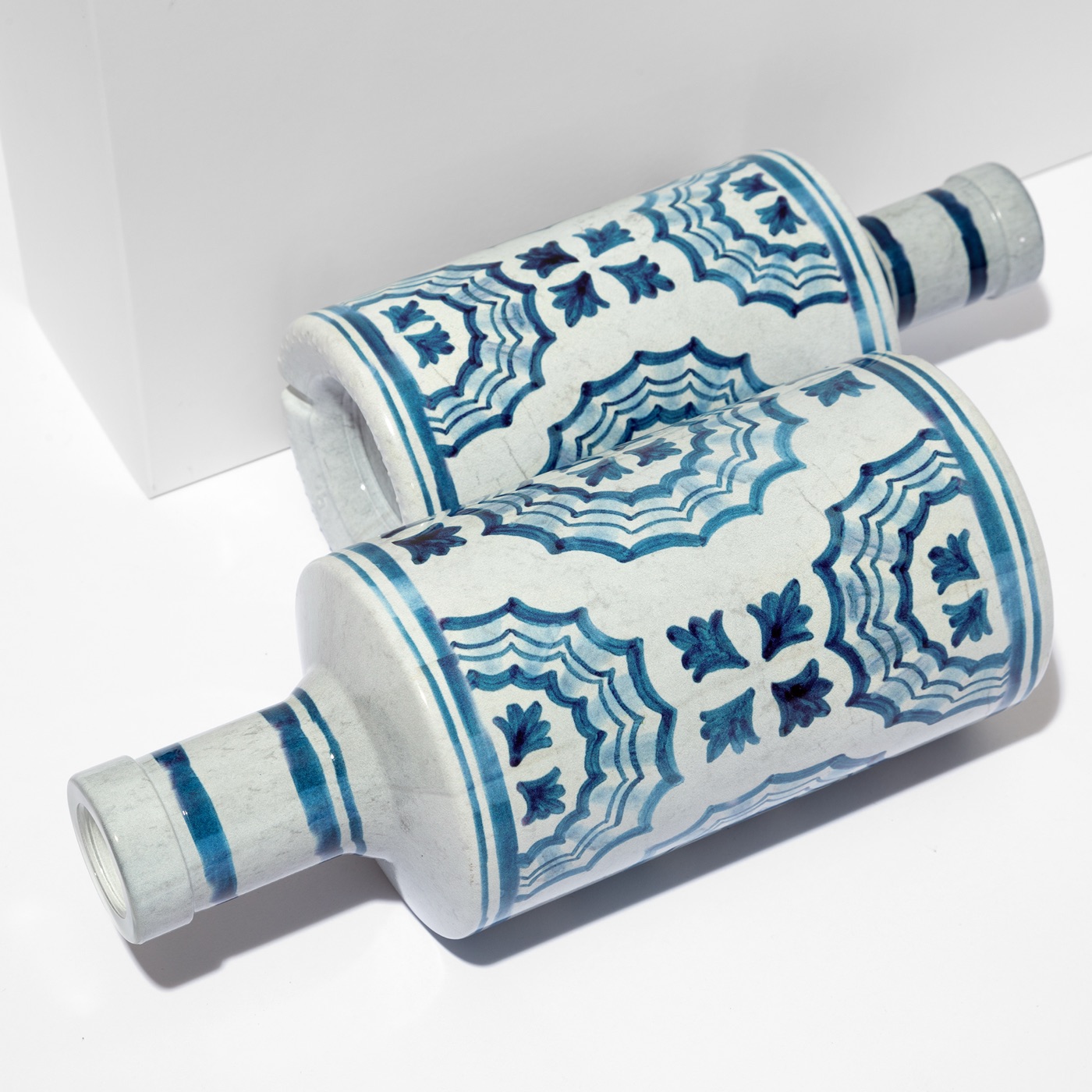
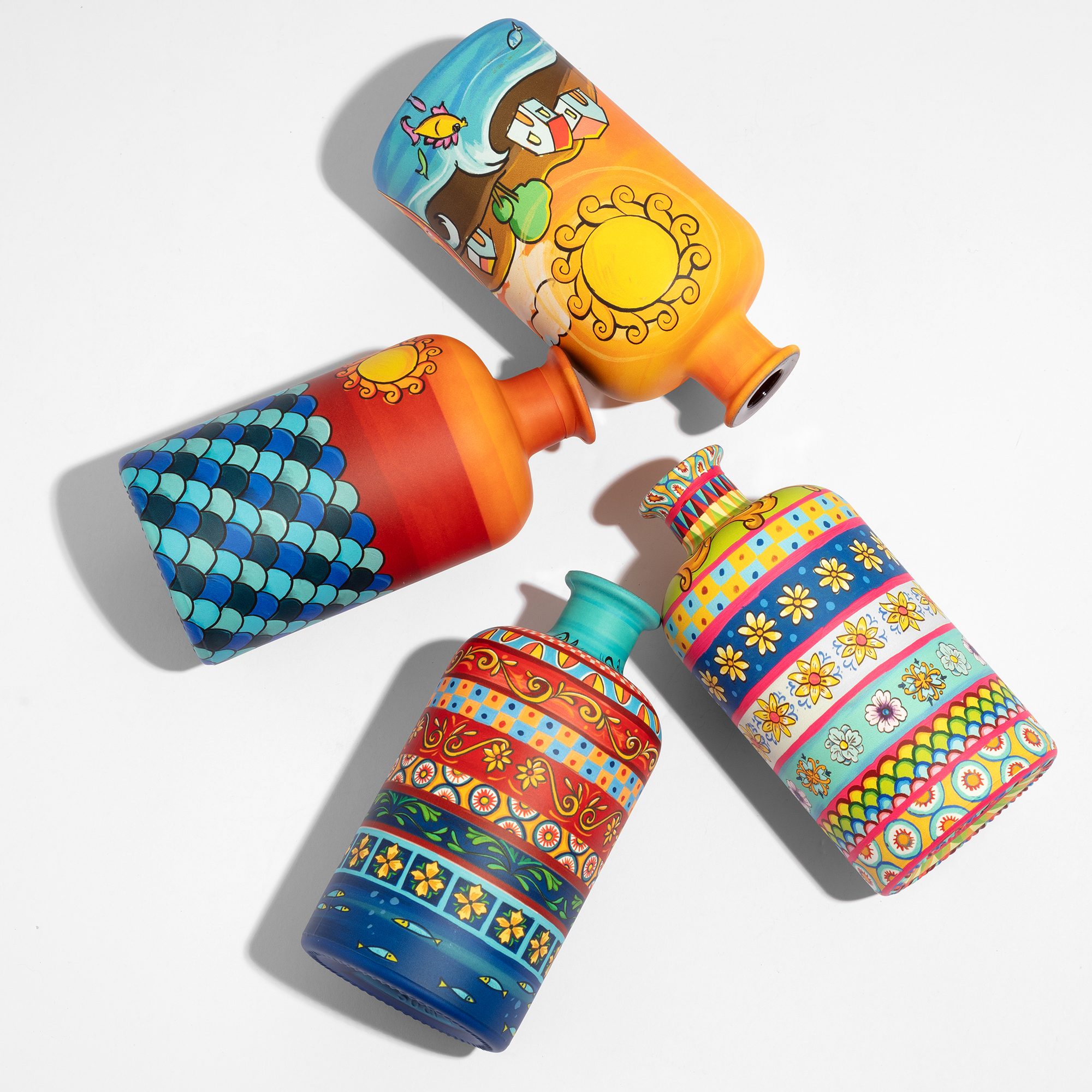
Every premium olive oil carries a sense of place, and terroir is arguably the product's soul in a way few other foods can match. Tuscan hills, Apulian groves, Ligurian terraces and the sun-worn islands of Greece each impart a distinct character to the oil, and a discerning buyer is paying as much for that origin story as for the liquid itself. Glass bottle decoration can express this visually at the scale of the whole bottle rather than a single label panel, wrapping the container in the landscape it came from. Sublimation enables landscape imagery, hand-drawn illustrations of olive branches and varietals, and the warm earth tones of the harvest to travel across the entire bottle surface at up to 1200 dpi resolution. Because the artwork can run 360 degrees around the glass, there is no seam and no back-of-pack afterthought, so the whole bottle becomes a continuous canvas. Centonze Ice Blue shows what this looks like in practice: a Sicilian extra virgin olive oil whose majolica-effect decoration wraps the island's ceramic tradition around the bottle, work recognised with Pentawards Gold 2025. The result feels genuinely artisanal, and that impression holds true whether a producer is bottling a few thousand units or scaling toward a much larger export programme. This is where sublimation excels for olive oil: it lets a small estate present itself with the visual ambition of a much larger house, without asking the design to shrink to fit a label.
Heritage and Typography
Many olive oil families have pressed oil across several generations, and that continuity is a real commercial asset in a market that prizes authenticity. Decoration that incorporates family crests, vintage typography, estate maps and founding dates reinforces heritage in a way consumers instinctively read as trustworthy. Sublimation reproduces fine serif typefaces, hairline rules and the intricate detail of an engraved emblem with a precision that suits this kind of storytelling, letting an estate render its coat of arms crisply rather than approximately. Every bottle then becomes a small statement of provenance, carrying the weight of the family name directly on the glass. This matters most for the premium and gift tiers, where the buyer is looking for reassurance that the oil inside is the work of people who have spent decades learning their groves. When a producer wants heritage cues to sit alongside contemporary design, sublimation handles both registers at once, holding a classical crest and a modern grid on the same surface without compromise.
Colour and Shelf Strategy on Dark Glass
Dark glass is not a stylistic choice for olive oil so much as a functional one, because tinted amber and deep green substrates protect extra virgin oil from the light degradation that turns it rancid. That protective colour does, however, change the decoration equation, since printing onto a dark substrate requires careful colour management to keep warm golds, deep greens and terracotta tones reading accurately rather than muddy. Sublimation is well suited to this: ATIU's colour management team in Verona builds tailored colour profiles for each glass colour and bottle shape, so that artwork approved on screen renders faithfully on amber, olive-green and clear glass alike. This is where the process shows its strength for the category, because it lets a producer commit to the dark glass their oil needs without sacrificing the vibrancy of their branding. Multiple primers are available to establish the ground for the inks, which helps whites and pale tones sit brightly even on the darkest bottles. The practical outcome is a bottle that both shields the oil and holds its shelf presence in a crowded gourmet aisle, so the packaging works for the product and the brand at the same time.
Durability Under Everyday Kitchen Use
An olive oil bottle does not live a sheltered life the way a fragrance flacon might, because it sits on kitchen counters and restaurant tables and is handled every single day. It gets picked up with oily hands, wiped down with a cloth, exposed to humidity near the stove and cleaned repeatedly over the months it takes to work through the oil inside. Sublimated decoration is built for exactly this environment, because the waterborne inks bond into the primer coating on the glass and become part of the surface rather than a layer sitting on top of it. There are no labels to lift at the corners and no printed area to absorb an oil drip, so the bottle looks the same after months on a busy pass as it did on the shelf the day it was bought. Curing takes place below 180°C, which sets the decoration permanently while keeping the process gentle, and because the inks carry no heavy metals and no solvents the finish is as clean as it is durable. For a brand that wants its bottle to be kept, refilled or displayed rather than quietly recycled after one use, that longevity is part of the value proposition.
Small-Batch and Single-Estate Editions
Artisan olive oil is very often a story of the single harvest, the single estate, and the single grove that had an exceptional year, which means production naturally comes in small, meaningful batches rather than uniform mass volumes. Traditional decoration methods that rely on plates or screens carry a setup cost that has to be spread across a run, so short editions have historically been expensive to decorate well. Sublimation removes that barrier entirely, because it needs no plates and no screens, which is what makes a run of a few thousand bottles for a single vintage genuinely viable rather than prohibitive. ATIU supports MOQs from around 5,000 units, and the same process scales to millions of units per project, so a producer can start with a limited estate edition and grow into a national listing on the same decoration platform. This flexibility is what lets a small producer behave like a design-led brand, treating each harvest as its own labelled release with its own artwork — Centonze Ice Blue began exactly this way, as a single Sicilian estate edition whose decorated bottle now stands as an awarded reference for the whole category. ATIU decorates olive oil bottles sourced from the producer's glassmaker of choice, supporting producers who want the freedom to tell a different story with every pressing.
Sustainability Producers Can Communicate
Premium olive oil buyers tend to be exactly the kind of consumer who reads the back of the pack and cares about environmental responsibility, so sustainability is not a side note for this category but part of the purchase decision. Sublimation aligns naturally with those values, because the process uses waterborne coatings and inks with no plastic, no solvents and no heavy metals, and cures at a temperature low enough to keep the whole operation gentle. Crucially, the decoration is a minimal surface layer, so the glass underneath stays fully recyclable at the end of its life rather than being contaminated by the artwork. ATIU's zero-net CO₂ status since 2023, its ISO 9001 certification and its EcoVadis engagement give producers verified credentials they can reference honestly in their own marketing, and the proprietary sublimation methodology behind this work was awarded Pentawards Gold 2025 for sustainability. For an olive oil brand built on the idea of clean, natural, place-driven quality, being able to decorate the bottle without compromising that promise closes the loop between what the oil represents and how it is packaged.